Key Takeaways
Key Takeaways
-
Preserved RMR protects against long-term weight regain.
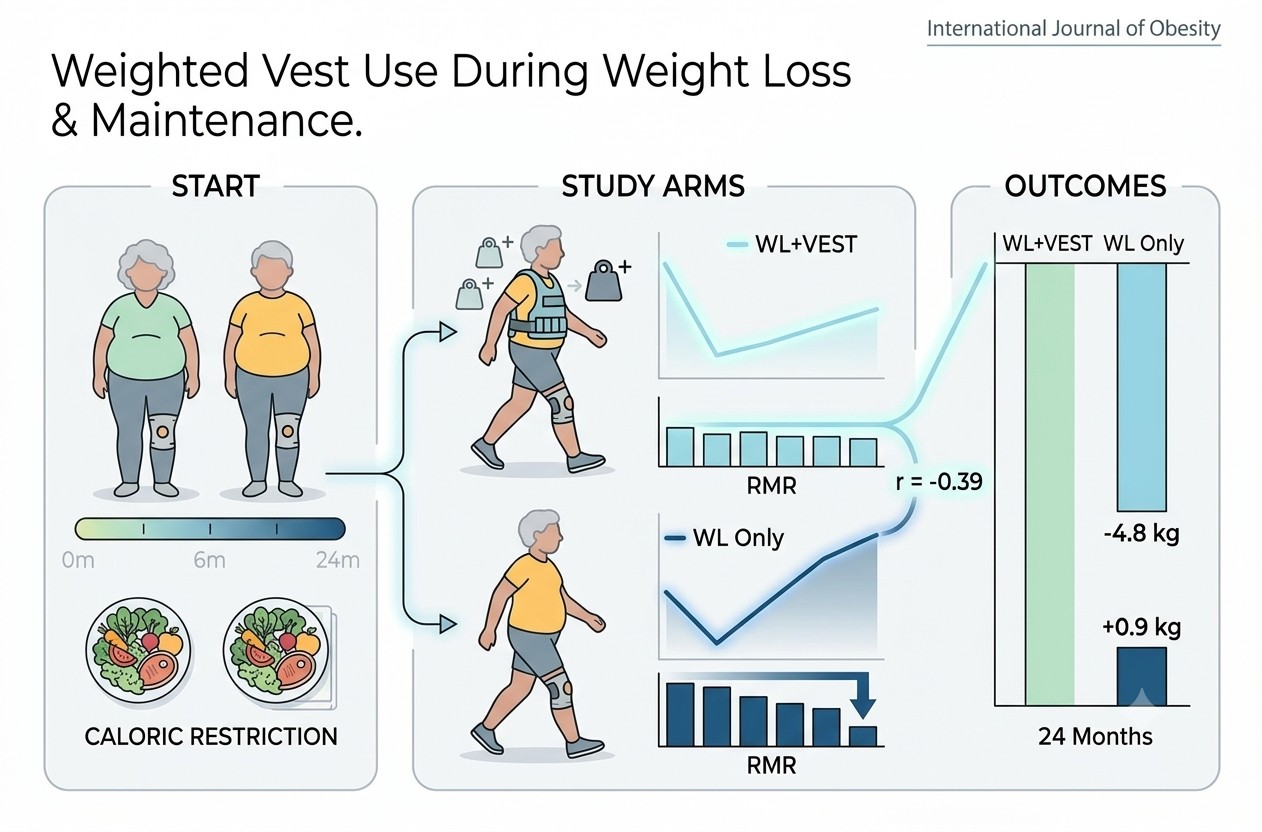
Traditional calorie-restricted weight loss causes resting metabolic rate (RMR) to drop, which drives post-diet weight regain; adding weighted vest loading during active weight loss preserves RMR and significantly reduces long-term weight regain. -
Simulating baseline body mass modulates the gravitostat.
By progressively adding weight to a vest to replace lost body mass, external loading engages bone-based mechanosensors (the gravitostat), preventing the systemic biological signals that typically slow metabolism when body mass decreases. -
Passive mechanical loading yields lasting post-intervention benefits.
Even after vest usage and dietary intervention cease, the metabolic preservation achieved during active weighted vest loading helps individuals retain approximately half of their weight loss over a two-year period compared to diet alone.
-
Preserved RMR protects against long-term weight regain.
Traditional calorie-restricted weight loss causes resting metabolic rate (RMR) to drop, which drives post-diet weight regain; adding weighted vest loading during active weight loss preserves RMR and significantly reduces long-term weight regain. -
Simulating baseline body mass modulates the gravitostat.
By progressively adding weight to a vest to replace lost body mass, external loading engages bone-based mechanosensors (the gravitostat), preventing the systemic biological signals that typically slow metabolism when body mass decreases. -
Passive mechanical loading yields lasting post-intervention benefits.
Even after vest usage and dietary intervention cease, the metabolic preservation achieved during active weighted vest loading helps individuals retain approximately half of their weight loss over a two-year period compared to diet alone.
The Physiology of Weight Regain: Adaptive Thermogenesis & The Gravitostat
When individuals lose body mass, total energy expenditure declines. A major contributor to this drop is a reduction in Resting Metabolic Rate (RMR)—the basal energy expenditure required to maintain basic cellular and metabolic functions at rest. Standard caloric restriction often causes a disproportionate drop in RMR relative to lost body mass (adaptive thermogenesis), predisposing individuals to regain lost fat stores once strict dietary compliance relaxes.
Historically, body weight regulation was understood primarily through central and hormonal pathways, such as leptin feedback loops. However, groundbreaking biomedical research has identified an additional peripheral biomechanical framework: the gravitostat hypothesis.
How the Gravitostat Works
- Osteocyte Mechanosensing: Lower-extremity osteocytes (bone cells) sense alterations in mechanical loading and gravitational force exerted by total body mass.
- Systemic Signaling: When body mass decreases, reduced mechanical force triggers osteocytes to send systemic feedback signals to the central nervous system.
- Metabolic & Appetite Modulation: The brain responds to reduced gravitational load by suppressing metabolic expenditure and elevating hunger cues to restore baseline body mass.
By introducing artificial external mass via a weighted vest during dietary weight loss, researchers can simulate pre-weight-loss gravitational loading, effectively modulating this biological sensor.
Clinical Trial Deep Dive: The DeLong et al. (2025) Study
To evaluate whether weighted vest loading preserves RMR and reduces post-diet weight regain in humans, researchers analyzed data from a long-term randomized trial involving older adults with obesity and self-reported osteoarthritis.
Study Methodology & Protocol
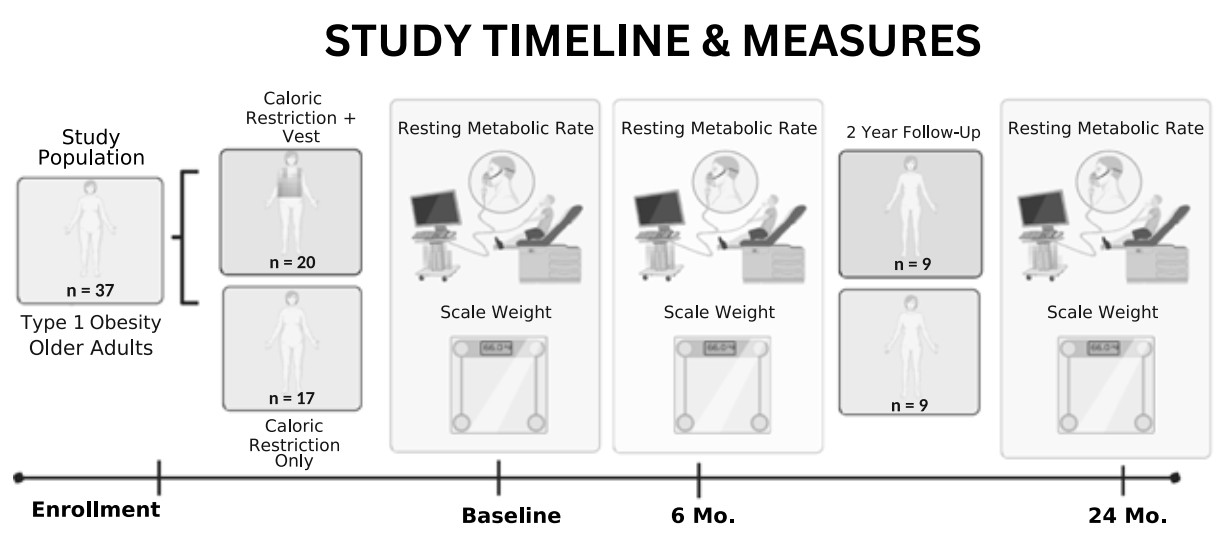
To test the long-term metabolic and weight-loss effects of artificial gravitational loading, researchers analyzed follow-up data from a randomized controlled trial (RCT) involving older adults living with obesity and self-reported osteoarthritis.
-
Participant Population: The analysis evaluated a sample of 18 older adults (average age: 70.4 ± 3.1 years; 83.3% female; 77.8% Caucasian) with an initial body mass index (BMI) of 35.2 ± 2.8 kg/m².
-
6-Month Active Phase: All 18 participants completed a 6-month dietary weight loss program without structured exercise. The dietary regimen utilized a structured meal replacement plan (1,100–1,300 kcal/day) paired with weekly nutritional and behavioral counseling led by a Registered Dietitian.
-
Group Allocation: Participants were randomized into two equal groups of 9 participants:
- Weighted Vest Group (WL+VEST, n=9): Wore an adjustable, low-profile weighted vest (Hyper Vest PRO®) during daily active hours (averaging 6.6 ± 2.2 hours/day). Vest weights were increased weekly to systematically replace 100% of lost body mass, up to a maximum cap of 15% of baseline body weight.
- Control Group (WL Only, n=9): Followed the exact same dietary weight loss protocol without vest loading.
-
24-Month Long-Term Follow-Up: Following the initial 6-month active phase, vest loading and dietary prescriptions ended, and participants were unmonitored for the subsequent year. Participants returned for follow-up testing at 24 months (average follow-up: 25.4 months) to measure body weight, lean mass via dual-energy X-ray absorptiometry (DXA), and resting metabolic rate via indirect calorimetry.
Key Findings: RMR Preservation & Long-Term Weight Maintenance
1. Equivalent Initial Weight Loss (0 to 6 Months)
During the active 6-month dietary phase, both cohorts achieved clinically significant and equivalent reductions in body mass:
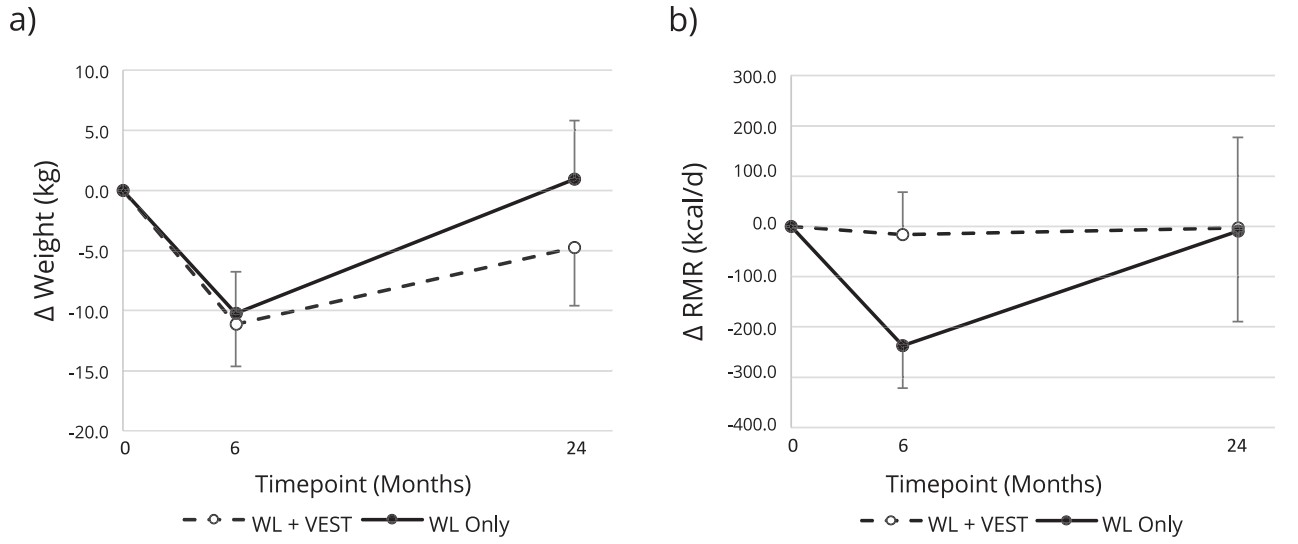
- WL+VEST Group: −11.2 kg (95% CI: −14.6, −7.7)
- WL Only Group: −10.3 kg (95% CI: −13.7, −6.8) (p = 0.71)
Lean mass loss was also equivalent between groups during active intervention (approximately 2.8–3.0 kg lost, representing roughly one-quarter of total weight loss).
2. Abolishment of RMR Reduction
The key physiological divergence occurred in resting metabolic rate. Standard caloric restriction in the control group triggered a severe metabolic drop, whereas weighted vest loading entirely abolished this decline:
- WL Only Group RMR Change (6 Months): −237.5 kcal/day (95% CI: −321.9, −153.0)
- WL+VEST Group RMR Change (6 Months): +16.3 kcal/day (95% CI: −100.8, 68.2)
- Between-Group Significance: p < 0.01
Preserving over 250 kcal/day in resting energy expenditure during active weight loss represents a profound biological advantage when transitioning into weight maintenance.
3. Long-Term Weight Regain Mitigation (24 Months)
Eighteen months after completing the active intervention and removing the weighted vests, follow-up assessments revealed striking differences in weight retention:
-
WL Only Group: Regained virtually all lost weight (+0.9 kg net change from baseline, 95% CI: −3.9, 5.8).
-
WL+VEST Group: Preserved approximately half of their initial weight loss (−4.8 kg net change from baseline, 95% CI: −9.6, 0.1).
-
Correlation: Changes in RMR during the active 6-month weight loss period demonstrated a negative inverse correlation with weight regain between months 6 and 24 (r = −0.39, p = 0.11). Participants who preserved their RMR experienced significantly less weight regain long-term.
How Weighted Vest Loading Fits into Weight Management Strategies
Comparison with Short-Term High-Load Interventions
Prior human research by Ohlsson et al. (2020) demonstrated that wearing high-load weighted vests (11% of body weight) for 3 weeks produced modest weight loss (1.37% relative reduction) without dietary restriction. However, the DeLong et al. (2025) study highlights a more actionable clinical protocol: combining structured caloric restriction with progressive weight replacement to safeguard metabolic integrity over extended periods.
Practical Implementation Considerations
- Target Wear Time: Participants in the trial averaged 6.6 ± 2.2 hours/day of vest wear during their daily routine.
- Progressive Loading: Replacing lost body weight incrementally maintains steady mechanical stimulation on lower-extremity mechanosensors without overstressing joint structures.
- Ergonomic Design: Utilizing an adjustable, low-profile vest (such as the Hyper Vest PRO® used in the study) allows users to wear load under standard clothing without restricting thoracic expansion or range of motion.
Study Limitations
While these findings offer promising insights into artificial gravitational loading, the authors highlight several key limitations that require consideration. Primarily, as a pilot study based on a convenience sample of 18 participants, the small sample size limits overall inferential power and generalizability, necessitating validation in larger, more diverse cohorts. Additionally, reliance on a convenience sample for the 24-month follow-up introduces potential sampling bias, though analytical adjustments were implemented to mitigate this risk. Finally, the study lacked granular tracking of daily protocol compliance—such as distinguishing between time spent wearing the vest while standing versus sitting—as well as long-term dietary intake monitoring during the unmonitored follow-up period.
Conclusion & Key Takeaways
The clinical evidence from DeLong et al. (2025) indicates that weighted vest loading represents a high-impact, passive intervention to counter adaptive thermogenesis during caloric restriction. By preventing the typical drop in resting metabolic rate during active weight loss, weighted vest usage provides long-lasting physiological protection against post-diet weight regain.
For clinical dietitians, fitness professionals, and individuals managing obesity, incorporating external loading into dietary weight loss protocols offers a research-backed framework for sustainable, long-term success.