Key Takeaways
-
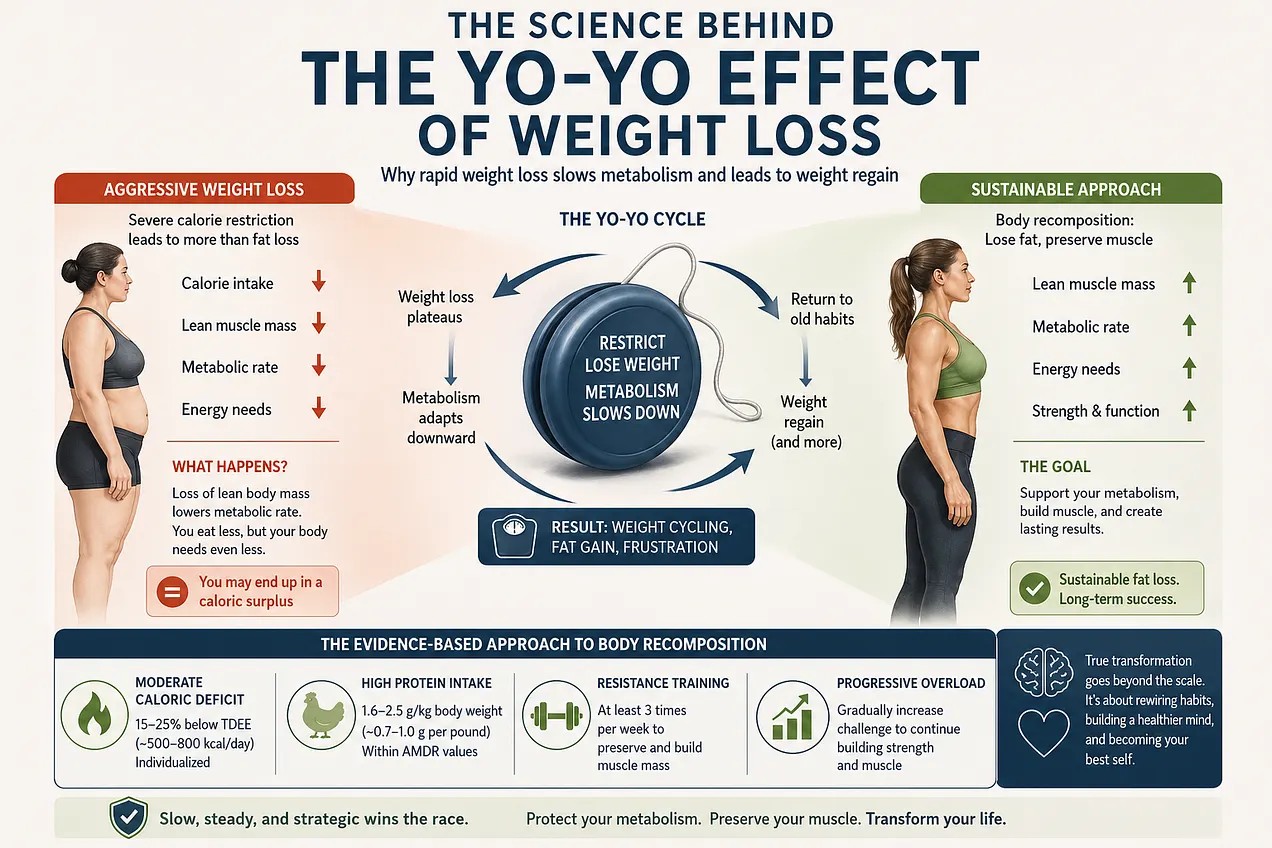
Prioritize Body Recomposition over Rapid Weight Loss: Aggressive calorie cutting leads to muscle loss and metabolic slowdown, which triggers the yo-yo effect. Focus on losing fat while maintaining muscle to keep your metabolism healthy.
-
Protect Your Metabolism: Lean muscle tissue burns more energy than fat. By combining moderate caloric deficits with high-protein intake and consistent resistance training, you can prevent “adaptive thermogenesis” and avoid weight loss plateaus.
-
Consistency Outperforms Speed: Long-term weight management is built on sustainable habits. A moderate deficit of 15–25% below TDEE, supported by progressive resistance training, ensures weight loss is permanent rather than temporary.
The Trap of Rapid Weight Loss
Patients who come to clinics for weight loss are often highly motivated to see fast results. Many believe that rapid fat loss will reinforce adherence and prevent lapses in willpower. However, in practice, the opposite often occurs. Despite significant caloric restriction, patients frequently report stalled weight loss or even gradual weight regain while consuming far fewer calories than before. This phenomenon is commonly perceived as the body “resisting” weight loss.
From a physiological standpoint, this response is not only expected, it is well documented in the scientific literature and is central to what is known as the yo-yo effect or weight cycling.
Understanding Metabolic Rate and Composition
At the core of this process is metabolic rate, often referred to as basal metabolic rate (BMR) or total daily energy expenditure (TDEE). This represents the total energy required to sustain essential biological functions, including organ activity, cellular processes, enzymatic reactions, and tissue repair. A key determinant of metabolic rate is body composition, particularly the proportion of lean body mass (muscle mass) versus fat mass.
Muscle tissue is metabolically active, meaning it requires significantly more energy to maintain compared to adipose (fat) tissue. Therefore, preserving lean body mass is critical for maintaining a higher metabolic rate.
Adaptive Thermogenesis and the Yo-Yo Effect
When weight loss is pursued aggressively, typically through severe caloric restriction, it often leads to a disproportionate loss of lean body mass in addition to fat mass. This reduction in muscle mass results in a measurable decline in metabolic rate, a phenomenon known as adaptive thermogenesis. As a result, the body becomes more energy-efficient, requiring fewer calories to function.
This creates a metabolic environment where an individual may consume what appears to be a modest caloric intake, yet still be in a caloric surplus relative to their new, reduced metabolic rate. Consequently, weight loss plateaus, and in many cases, weight regain begins. This is the physiological basis of the yo-yo effect.
It is important to note that this metabolic adaptation is most pronounced in cases of aggressive weight loss. Individuals aiming for modest fat loss (e.g., 2–3 kg or 4–6 pounds) combined with muscle gain are far less likely to experience significant metabolic downregulation.
The Strategy: Body Recomposition
From a clinical nutrition perspective, the most effective strategy is not rapid weight loss, but sustainable fat loss with muscle preservation, commonly referred to as body recomposition.
Body recomposition focuses on reducing fat mass while maintaining, or even increasing, lean body mass. This approach supports metabolic health, improves long-term weight management, and enhances overall physical function.
Evidence-Based Recommendations
A practical, evidence-based approach includes:
- Implement a Moderate Deficit: Aim for a caloric deficit of approximately 15–25% below TDEE (typically ~500–800 kcal/day, individualized).
- Prioritize Protein: Consume a high-protein diet (approximately 1.6–2.5 g/kg body weight or ~0.7–1.0 g per pound) to support muscle protein synthesis and satiety.
- Engage in Resistance Training: Perform resistance training at least 3 times per week.
- Apply Progressive Overload: Continually challenge your muscles to stimulate retention and growth.
Conclusion
Ultimately, successful weight loss is not defined by how quickly weight is lost, but by the ability to maintain fat loss long-term without metabolic compromise. Sustainable results require not only physiological adaptation, but also behavioral and neurological changes, establishing habits that support a healthier, more resilient lifestyle. In this context, the goal is not simply to lose weight, but to transform body composition, metabolic health, and long-term habits.