
Key Takeaways
-
Dose-Response Relationship: There is a well-established positive correlation between weekly set volume and muscle hypertrophy; generally, higher volumes lead to greater muscle growth, characterized by diminishing returns rather than a hard ceiling.
-
Defining the Range: While 12–20 sets per week is often cited as an optimal guideline, current evidence suggests that the “maximal” dose is highly individual and depends on recovery capacity, with no clear biological plateau identified in recent large-scale meta-analyses.
-
The Power of Efficiency: Hypertrophy can be induced with as few as ~4 fractional weekly sets (minimal effective dose), meaning individuals can tailor their volume based on their specific goals, recovery status, and time constraints rather than striving for an arbitrary “maximum.”
The Dose-Response Relationship: More is Often Better
Resistance training may be the most efficient way to induce hypertrophy, and its volume—commonly measured in weekly sets—is considered a primary stimulus for muscle growth. The scientific discussion regarding the optimal number of weekly sets required to maximize hypertrophy is grounded in at least three seminal papers. The conceptual development of this topic begins with the observation of a positive correlation between training volume and hypertrophy; that is, higher training volumes are generally associated with greater hypertrophic adaptations. Building on this relationship, key questions arise: What is the precise nature of this dose–response relationship? Does “more” always lead to “better” outcomes, or is there a ceiling beyond which additional volume no longer produces further gains? Ultimately, how many weekly sets should be performed to maximize hypertrophy?
The 15-Set Threshold
In their randomized controlled trial, Schoenfeld et al. (2019) examined thirty-four healthy resistance-trained men who were randomly assigned to one of three experimental groups: a low-volume group performing one set per exercise per training session (n = 11), a moderate-volume group performing three sets per exercise per training session (n = 12), or a high-volume group performing five sets per exercise per training session (n = 11). Training across all groups consisted of three weekly sessions performed on nonconsecutive days for eight weeks.
Muscular strength was assessed using one-repetition maximum (1RM) testing for the squat and bench press. Upper-body muscular endurance was evaluated using a bench press test at 50% of 1RM performed to momentary failure. Muscle hypertrophy was assessed using B-mode ultrasonography of the elbow flexors, elbow extensors, mid-thigh, and lateral thigh.
The results demonstrated a dose–response relationship between training volume and muscle hypertrophy, with progressively greater gains observed at higher training volumes. In this study, the highest volume examined corresponded to approximately 15 weekly sets; however, it remains unclear whether further increasing weekly set volume beyond this threshold would continue to enhance hypertrophic adaptations.
Beyond 15 Sets: The Meta-Analytical View
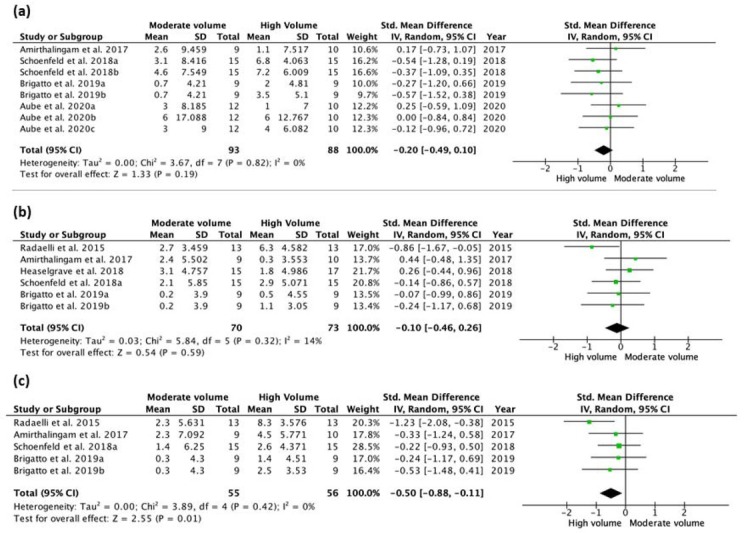
A meta-analysis by Baz-Valle et al. (2022) is often cited as evidence for the optimal number of weekly sets required to maximize hypertrophy, though it has limitations. Seven studies met the inclusion criteria for qualitative analysis, while only six were included in the quantitative analysis. Participants were categorized into three volume groups: “low” (<12 weekly sets), “moderate” (12–20 weekly sets), and “high” (>20 weekly sets).
According to the results, no significant differences were observed between moderate and high training volumes for hypertrophy of the quadriceps (p = 0.19) and the biceps brachii (p = 0.59). However, a significantly greater hypertrophic response was observed in the triceps brachii in the high-volume group (p = 0.01). Based on these findings, the authors proposed that a range of 12–20 weekly sets per muscle group may represent an optimal guideline for promoting muscle hypertrophy in young, trained men. Key limitations include the small number of studies (n = 7) and limited muscle groups analyzed. Notably, the triceps brachii appeared to benefit from training volumes exceeding 20 weekly sets, and there is a visible, albeit non-significant, trend favoring higher training volumes in both the quadriceps femoris and biceps brachii.
Redefining Volume: The Continuous Approach
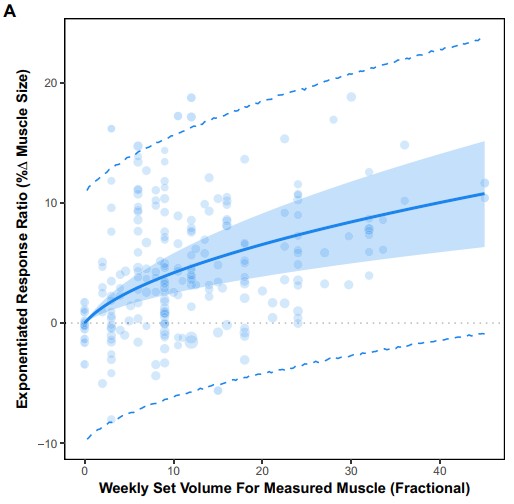
Pelland et al. (2026) conducted a meta-analysis using a different analytical approach that provides new insights into the relationship between training volume and hypertrophy. This 2026 dataset includes significantly more studies, providing greater statistical power. The authors implemented two methodological advances: (1) they did not pool volume into discrete categories but treated weekly set volume as a continuous variable; and (2) they accounted for fractional sets.
Fractional sets assign partial credit to synergist muscles; for example, one set of bench press is counted as one set for the pectoralis major and 0.5 sets for the triceps. This meta-analysis included 67 studies and 2,058 participants (79.1% male, 20.9% female; mean age 25.16 ± 5.2 years). Consistent with previous findings, the results showed that increases in muscle hypertrophy continue to rise with increasing training volume, albeit with diminishing returns. However, no clear plateau in hypertrophic adaptations was identified.
Diminishing Returns and Efficiency Tiers
By analyzing continuous data, it is possible to identify the point of diminishing returns as a function of weekly set volume. Diminishing returns refer to the range of weekly sets beyond which further increases in volume produce progressively smaller gains in muscle hypertrophy; essentially, greater training effort yields progressively smaller returns. Detectable hypertrophy was observed at approximately four fractional weekly sets, suggesting a minimal effective dose. Regarding the maximal effective dose, this analysis did not identify an upper limit for hypertrophic adaptations within the observed data range.
Practical Implications
The practical implications depend on an individual’s goal and training experience.
-
If the goal is to gain muscle with minimal effort, targeting the lower volume range of approximately 4–10 weekly sets may be sufficient, while still allowing for meaningful hypertrophic gains (including fractional set counting).
-
If the goal is to maximize hypertrophy, it may be beneficial to experiment with higher training volumes beyond ~18 weekly sets per muscle group—such as 20–24 sets, as this can produce additional, albeit marginal, gains. However, caution is warranted to avoid excessive fatigue. Continued performance progression is a good indicator of adequate recovery and effective training, whereas stalled progress may signal accumulating fatigue, which can ultimately hinder gains and lead to the opposite of the intended outcome. Don’t hesitate to work hard, but do so intelligently.
-
Higher training volumes require greater attention to recovery, including adequate sleep, nutrition, and rest, in order to minimize injury risk and avoid performance plateaus.