
Key Takeaways
Key Takeaways
-
One bad night won’t ruin your progress.
Acute sleep loss can slightly reduce workout performance—especially for skill-based activities—but a single poor night’s sleep is unlikely to impair your long-term training adaptations. -
Adjust your workout instead of skipping it.
If you’re sleep-deprived, consider reducing the training load or volume, avoid training to failure, and prioritize good technique. When possible, schedule your workout earlier in the day. -
Focus on long-term sleep quality.
Occasional sleep loss is manageable, but chronic sleep deprivation has a much greater impact on recovery, muscle growth, performance, and overall health. Consistently getting enough sleep is one of the most effective ways to maximize training results.
Should You Exercise After a Bad Night’s Sleep?
Everyone knows sleep is important, but life doesn’t always cooperate. Whether it’s work, parenting, travel, or stress, most of us occasionally end up training after a poor night’s sleep.
So what actually happens to your performance? Is it worth sticking to your workout, or should you skip it and recover?
Let’s see what the evidence tells us.
How Much Does One Bad Night Affect Performance?
Feeling tired is obvious, but does sleep loss actually reduce physical performance?
A large meta-analysis by Craven and colleagues analyzed 69 studies encompassing 227 performance outcomes to investigate the effects of acute sleep restriction—defined as sleeping six hours or less within a 24-hour period.
The researchers grouped exercise into several categories:
- Maximal strength and muscular endurance
- Anaerobic power
- Speed and repeated-sprint performance
- Endurance exercise
- Skill-dependent performance
- High-intensity interval exercise
The overall conclusion was straightforward: acute sleep loss consistently impaired performance across nearly every type of exercise.
However, not all activities were affected equally.
Tasks requiring coordination, precision, balance, or rapid decision-making showed the greatest decline. Strength and power were comparatively more resilient, although they still suffered measurable reductions.
How Large Is the Effect?
Fortunately, the impact of a single poor night is relatively modest.
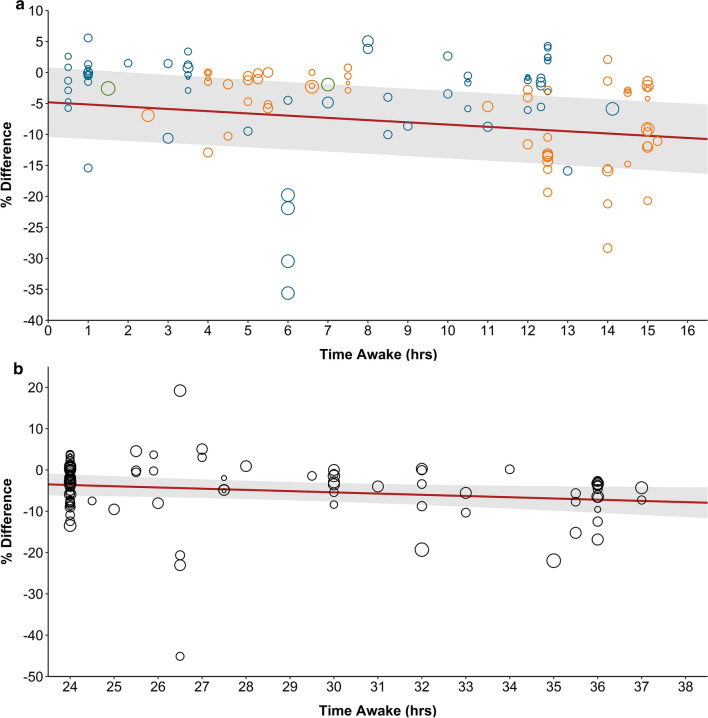
On average, performance declined by approximately 0.4% for every additional hour spent awake before exercise.
That may seem insignificant, but the effects accumulate.
For example, sleeping only four hours before training may reduce performance by roughly 2–3% (Figure 1). In practical terms, that could be the difference between completing your planned repetitions or missing the final rep of a heavy set.
For recreational exercisers, this reduction is unlikely to meaningfully affect long-term progress, but competitive athletes may notice even these small changes during important training sessions or competitions.
Does the Type of Sleep Loss Matter?
Interestingly, how you lose sleep appears to influence performance.
The greatest impairments were observed after:
- Complete sleep deprivation (an all-nighter)
- Going to bed much later than usual
In contrast, waking up earlier while maintaining your normal bedtime produced smaller performance losses.
This suggests that, when possible, maintaining your regular bedtime may be preferable to sacrificing the beginning of the night.
Is It Better to Train in the Morning?
Timing also appears to matter.
Following a poor night’s sleep, evening workouts generally experienced greater performance declines than sessions performed earlier in the day.
A likely explanation is that sleep pressure continues to build as the day progresses, making fatigue progressively worse.
If your schedule is flexible, moving your workout to the morning may help minimize the effects of sleep loss.
The same principle can apply outside the gym. If you’re deciding between staying up late to finish work or waking up earlier to complete it, the available evidence suggests that protecting your usual bedtime may be the better option.
Why Does Sleep Loss Reduce Performance?
Several physiological and neurological mechanisms likely contribute to the decline.
A review by Fullagar and colleagues identified several important factors:
Increased sympathetic (“fight-or-flight”) activity alongside reduced parasympathetic recovery. Reduced glycogen restoration after severe sleep deprivation. Elevated inflammatory responses. Slower reaction times and poorer decision-making. Impaired motor learning and reduced consolidation of newly acquired movement skills.
Sleep loss can also increase the perceived effort of exercise. In other words, the same workout often feels harder, even when objective performance declines only slightly. This increase in perceived exertion may partly explain why motivation to train is often lower after a poor night’s sleep.
Should You Skip Your Workout?
In most cases, probably not.
Although one night of poor sleep can reduce performance, it is unlikely to meaningfully impair your long-term training adaptations if your overall sleep habits are good.
Instead of cancelling the session entirely, consider making small adjustments:
- This may not be the right day to aim for your personal record.
- Reduce the training load slightly.
- Leave one or two repetitions in reserve rather than pushing to failure.
- Delay particularly technical or high-skill sessions if possible.
- Pay extra attention to exercise technique, since fatigue can increase movement errors and potentially elevate injury risk during complex lifts or sports requiring precision.
If sleep deprivation becomes a frequent pattern rather than an occasional event, the consequences extend far beyond a single workout. Chronic sleep restriction can negatively affect recovery, muscle protein synthesis, hormonal regulation, immune function, and long-term training adaptations. If insufficient sleep is unavoidable due to your lifestyle, it is important to adjust your training plan accordingly by reducing intensity, volume, or expectations. However, if sleep loss is a matter of choice, prioritizing adequate sleep should be considered part of your training strategy. Consistently training while under-recovered may limit performance gains and increase the risk of injury.